With the start of a new school year, teachers everywhere have been busy getting to know their students and planning ways to complement their individual needs. One of the ways teachers learn about their students’ academic needs is through the administration of a universal screener.
What is a Universal Screener?
A universal screener is a brief, systematic assessment that is used to gauge where children are at the beginning of the year in terms of their foundational and oral reading skills. It usually takes between 4 to 9 minutes per student to administer depending on the grade level (K-2). The purpose of the screening is to identify those students who may need additional support to meet grade level expectations. Using a free universal screener such as Acadience Reading at the beginning of the year is crucial for identifying students who may be at risk for reading failure. Acadience Reading is a valid and reliable set of curriculum-based measures for reading that assess students’ development as readers. Each assessment is designed for a specific grade level ranging from K-6 and measures critical skills for early readers. After the initial screening at the beginning of the year, students are progress monitored periodically and screened again at the middle of the year and at the end of the year. For more information on universal screening, go here.
Why is Screening All Students Important?
Data from universal screening is used to inform instruction and determine the appropriate support for each student. We need to catch students early in grades K and 1, when they are still building their foundational skills and learning how to map phonemes to the graphemes that represent them in their brains, so that they can decode words and eventually be able to read fluently. Reading fluently means reading with accuracy and automaticity thereby allowing their cognitive energies to be focused on comprehension, not the laborious task of decoding each word.
What Do We Do With the Data?
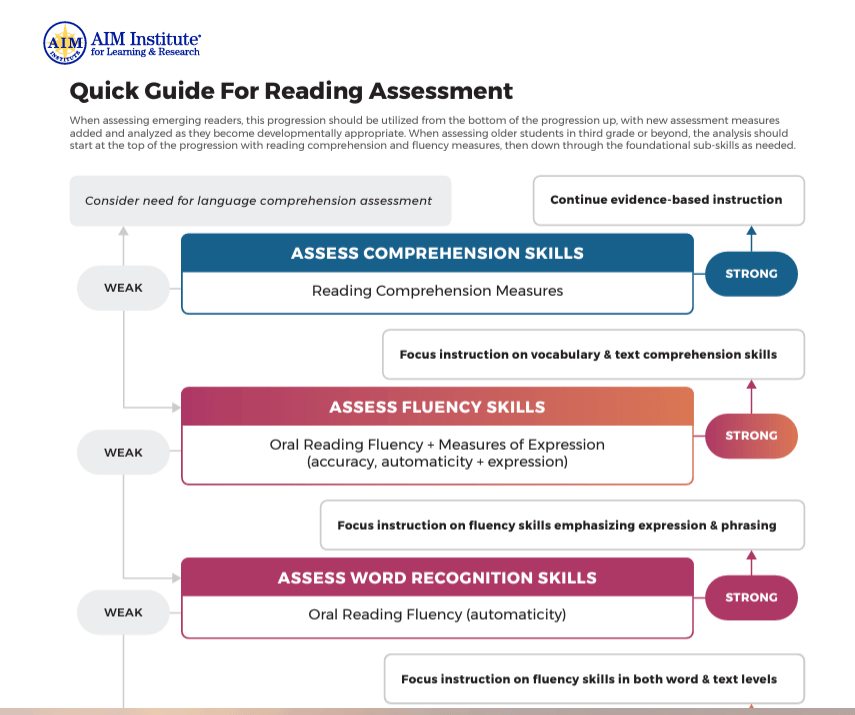
Now that you’ve screened your students, you need to analyze the data. What good is having so much data if we don’t use these data to provide the needed support for students we identify as struggling or at risk. Consider using this excellent Quick Guide for Reading Assessment from AIM Institute and the Four Questions to Ask After Universal Screening from the National Center on Improving Literacy to help you analyze and reflect on the Acadience Reading data. After carefully analyzing and reflecting on your beginning of the year data, you need to sort your students based on their areas of need as well as their strengths. You may find this grouping chart helpful.
What Do I Teach in My Small Groups?
Now that you have grouped your students based on the screening data, it’s time to think about specific needs of each group. You need to use your screening data to create small, skill-based groups to ensure that you provide each student with the needed support they need. Dr. Stephanie Stollar’s grouping worksheets further support teachers in planning for small group instruction by providing the focus for small group based on the screening data for beginning, middle, and end of year. You can download these grouping worksheets for free; but you need to create an account first.

What Do I Teach in My Small Groups?
For students who performed at or above benchmark, you need to consider strengthening core instruction by teaching the program with integrity while providing strategic and/or intensive support to students who exhibit specific deficiencies (those students scoring in the “Below” and “Well Below” Benchmark range) so they can achieve mastery. Utilizing quality instructional materials will help you accelerate learning for those students and help them achieve better results on the middle of the year benchmark assessment. You also need to monitor progress more frequently (weekly for well-below students) to ensure that the interventions are helping them make adequate progress to attain the benchmark goal and/or their reading goals.
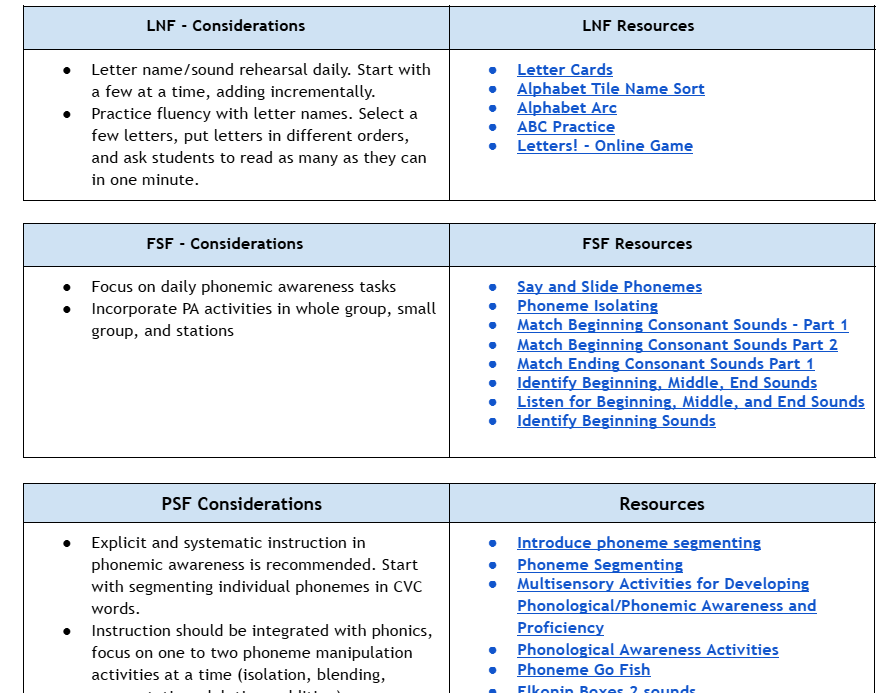
I have created and compiled the following Small Group Instructional Resources in Response to Acadience Data chart to support you in readily accessing tools and resources to support your planning for small group instruction. These are meant to be scaffolds and supports to strengthen students’ specific deficiencies, thereby improving results on the Acadience Reading MOY Benchmark Assessment. The goal is to improve students’ skills and not to “teach to the test.” We start with the areas in need of improvement to give us guidance in grouping students with similar needs and identifying a place to start where we can focus on what we need to work on to get them where they need to be.
I hope you found this information and resources helpful. If you have any questions, please feel free to email me at noorliteracy@gmail.com or comment below. Consider joining my mailing list and visit my website for more resources.
Discover more from
Subscribe to get the latest posts sent to your email.
 literacyinsight.com